Confucius Museum Review
Museums · Qufu, China. The Confucius Museum in Qufu, China, serves as a dedicated institution focusing on the life, philosophy, and enduring cultural impact of Confucius, one of China’s most influential historical figures. Qufu, Confucius’s birthplace, provides a…
Museums · Qufu, China. The Confucius Museum in Qufu, China, serves as a dedicated institution focusing on the life, philosophy, and enduring cultural impact of Confucius, one of China’s most influential historical figures. Qufu, Confucius’s birthplace, provides a…
Best forMuseum lovers, culture travelers, first-time visitors
Review focusCollections, visitor experience, and practical planning
Historical Context
The Confucius Museum in Qufu, China, serves as a dedicated institution focusing on the life, philosophy, and enduring cultural impact of Confucius, one of China’s most influential historical figures. Qufu, Confucius’s birthplace, provides a fitting geographical context for the museum, anchoring it in the traditional heartland of Confucian thought. The museum aims to trace the development of Confucianism from its origins in the 6th century BCE through its various interpretations and implementations across Chinese history and beyond.
Confucius’s influence spans education, governance, ethics, and social conduct, and the museum situates itself as a cultural and educational resource reflecting these domains. Given the complex historical layers of Confucianism—ranging from its inception during the Eastern Zhou Dynasty, through its elevation as a state philosophy under various dynasties, to its role in modern Chinese society—the museum’s collection and exhibitions endeavor to communicate both the continuity and evolution of Confucian ideas. This positioning is important because it relates the philosophical heritage not only to scholarly traditions but also to contemporary cultural identity in China.
What You See on Arrival
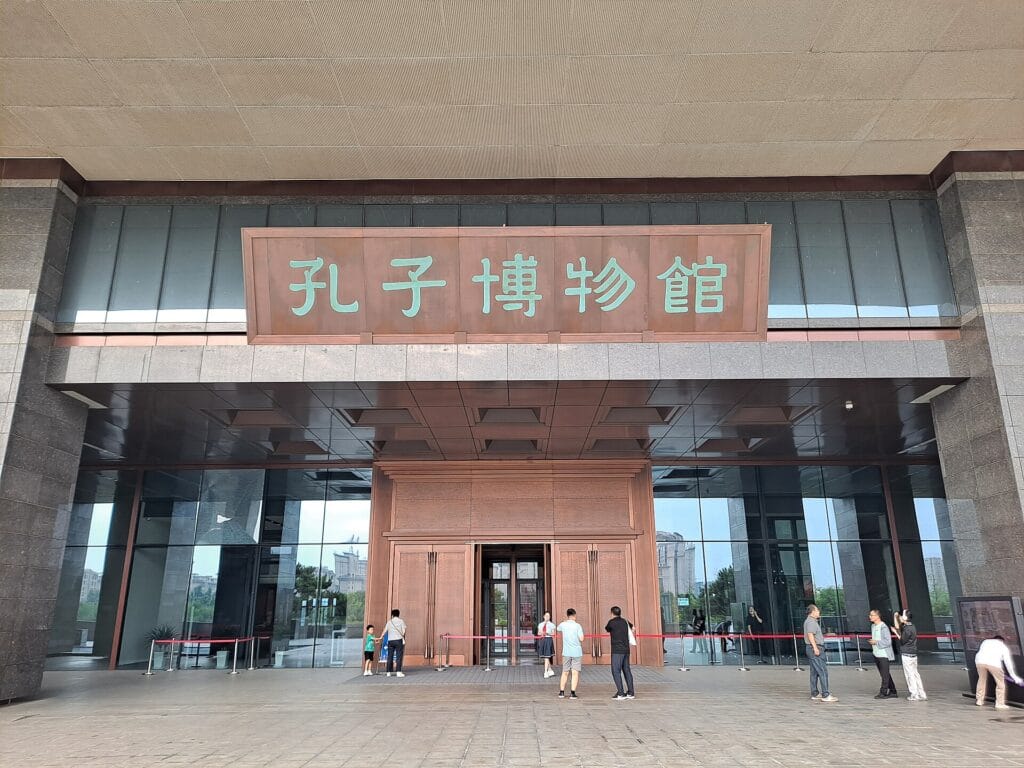
Approaching the Confucius Museum, visitors will encounter a complex that is architecturally reflective of traditional Chinese aesthetics intertwined with modern museum design. This fusion underscores the museum’s dual role: preserving and presenting an ancient heritage in a contemporary institutional setting. The external spaces often include courtyards and gardens, elements consistent with Confucian ideals of harmony with nature and order.
The museum’s entrance typically establishes an immediate recognition of Confucius’s stature, often through prominent statues or reliefs. This framing sets the tone for the visit, inviting contemplation and respect rather than entertainment or spectacle. The signage and visitor orientation usually emphasize a focused thematic approach, steering visitors towards an understanding of Confucianism as a living tradition rather than only a historic artifact.
Inside, the spatial layout commonly guides visitors thematically or chronologically. Orientation panels or introductory exhibitions provide necessary context about Confucius himself, the socio-political landscape of his time, and the broad ramifications of his teachings in successive Chinese dynasties. This initial framing is crucial for situating the objects and displays that follow.
Highlights and Key Exhibitions
The core of the Confucius Museum’s appeal lies in its assemblage of artifacts, texts, and multimedia presentations relating to Confucius and Confucianism. Expect to find ritual bronzes, calligraphy, ancient texts, and portraits that illuminate the intellectual and cultural environment of Confucius and his followers.
One important thematic area deals with Confucius’s biography and early historical context. Here, visitors can learn about the societal conditions that shaped his philosophy—specifically the emphasis on ethics, filial piety, ritual propriety, and governance. Items displayed often include replicas or original documents from the period, such as versions of the Analects, ceremonial objects used in Confucian rituals, and ancient manuscripts.
Another significant section addresses the transmission and institutionalization of Confucianism in Chinese history. This part explores how Confucian ideals were incorporated into imperial examination systems and governmental administration, shaping the social fabric for millennia. Exhibitions might include portraits of famous Confucian scholars, imperial edicts, and artifacts related to Confucian academies and temples.
A further highlight is the presentation of Confucianism’s broader cultural influence, including its impact on the arts, education, and social ethics. Visitors might encounter calligraphy exemplifying the Confucian ideal of moral cultivation, traditional musical instruments used in Confucian ceremonies, and representations of Confucian rites still practiced in Qufu and elsewhere.
Significantly, the museum also shows how Confucian ideas have persisted and adapted into modern times, reflecting on their role in contemporary Chinese society and education. This continuity is important in understanding Confucianism as a living tradition with evolving applications rather than a static relic.
Overall, the museum’s exhibitions rely heavily on a combination of original artifacts and interpretative displays that link ancient philosophy to tangible cultural objects. While the museum’s narrative can occasionally feel formal or academic, this is consistent with the subject matter’s gravitas. Visitors interested in Chinese philosophy, classical literature, or cultural history will find substantial material to engage with.
Visitor Experience
The Confucius Museum’s pace is generally slow and contemplative, suiting visitors who prefer thoughtful engagement over brisk walkthroughs. The presentation style emphasizes clarity and depth, which can be rewarding for those with some background or interest in Chinese culture and philosophy but may feel dense to casual visitors without prior knowledge.
Interpretive texts and labels are designed to provide historical context and philosophical interpretation, though language considerations may vary. Museums like this often offer Chinese and English explanations, but the depth and accessibility of the translations can influence the visitor’s understanding, particularly for those unfamiliar with Confucian terms and concepts.
The museum’s spatial arrangement and exhibit design encourage a sequential progression through Confucius’s life and legacy, rather than a dispersed or thematic hop. This approach tends to work well for storytelling but might not suit visitors seeking more interactive or multimedia features.
The largely traditional presentation style may limit appeal to younger audiences or visitors expecting modern exhibition technologies. However, those interested in cultural heritage, intellectual history, or Chinese traditions will likely appreciate the range and quality of the displays. The museum’s atmosphere tends to be quiet and respectful, reinforcing the contemplative nature of this cultural and philosophical journey.
The museum’s location in Qufu also means it forms part of a cluster of Confucian cultural heritage sites, so visitors should consider the Confucius Museum as one stop in a broader itinerary including the Confucius Temple, Cemetery, and Mansion. Consequently, some context and interpretation may rely on cross-referencing with these related sites.
Tickets, Access, and Planning
Specific and up-to-date details about entrance fees, discounts, hours, guided tours, and accessibility should be confirmed through the museum’s official channels before planning a visit. Public information on these practical details is generally available, but terms and availability can change, reflecting seasonal variations or policy updates.
The Confucius Museum’s location in Qufu facilitates access via regional transport networks, but international visitors may require additional planning to coordinate arrival into this city compared to major Chinese urban centers. Local signage and visitor services are typically oriented towards domestic tourism, which might affect language availability or ease of navigation for some travelers.
Given the museum’s integration into a broader cultural landscape, visitors should allow time not only for the museum itself but also for the surrounding Confucian heritage sites to gain full perspective. This consideration is important for effective trip planning, as the museum is generally distinct in focus and content from these other sites, which often emphasize architectural, ceremonial, or genealogical aspects.
Final Verdict
The Confucius Museum in Qufu offers an in-depth and structured presentation of Confucius’s life and legacy, situated within its historical and cultural heartland. Its strength lies in clear thematic exhibits combining artifacts, textual materials, and interpretive content that elucidate Confucian philosophy and its historical development.
While the museum does not prioritize interactive or entertainment-focused displays, this restraint suits an institution centered on a deeply intellectual tradition. Visitors with interests in Chinese history, philosophy, and cultural heritage will find valuable resources and a coherent narrative structure. Yet, those without familiarity or particular curiosity regarding Confucian ideals might find the experience more challenging or slower paced.
As part of a larger set of Confucian heritage attractions in Qufu, the museum complements the broader landscape of historical and cultural interest but should be approached as a serious educational opportunity rather than a casual exploration. Practical details should be checked in advance, especially for non-Chinese speaking visitors, as some orientation and service aspects may vary.
Overall, the Confucius Museum serves as a solid institutional reference point for understanding one of China’s pivotal cultural and philosophical legacies. It holds considerable relevance for scholars, cultural enthusiasts, and travelers seeking a concentrated view of the Confucian tradition, balanced by an awareness of its formal and somewhat academic exhibition style.