Tokyo National Museum
About: A calm, beautifully paced museum. Pick one building and do it properly. The garden is a quiet reset.What to see: Start with the signature.

Best forMasterpieces, architecture, cultural history
Setting / nearbyAsia
Overview
Tokyo National Museum is one of the most important museums in Japan and one of the best places in the world to understand Japanese art, antiquities, and material culture across a long historical span. Located in Ueno Park, it is not a museum built around noise, spectacle, or a single blockbuster attraction. Its strength lies in depth, calm pacing, and the extraordinary quality of the objects on display. For many visitors, it becomes one of the most rewarding museum experiences in Tokyo because it offers something the city itself often does not: stillness, continuity, and long historical perspective.
What makes the museum especially rewarding is that it presents Japanese culture through objects that are often modest in scale but immense in refinement. Swords, ceramics, screens, Buddhist sculpture, lacquerware, textiles, calligraphy, armor, archaeological material, and painted scrolls are all shown in a way that allows their differences in function, period, and style to become legible. This is one of the museum’s greatest strengths. It does not ask visitors to respond only to the biggest or most dramatic work. Instead, it teaches a slower kind of looking. A vessel, a robe, a scroll fragment, or a small sculpture can carry as much meaning as a monumental object when seen in the right context.
The museum is also especially valuable because it helps visitors understand Japanese art on its own terms. Rather than forcing everything into comparisons with Western painting or sculpture, it gives space to media and traditions that belong to different visual priorities. Folding screens, ink painting, Buddhist imagery, decorative arts, arms and armor, and archaeological objects all appear not as side categories, but as central parts of the story. This gives the institution much greater breadth than a museum focused only on one definition of fine art.
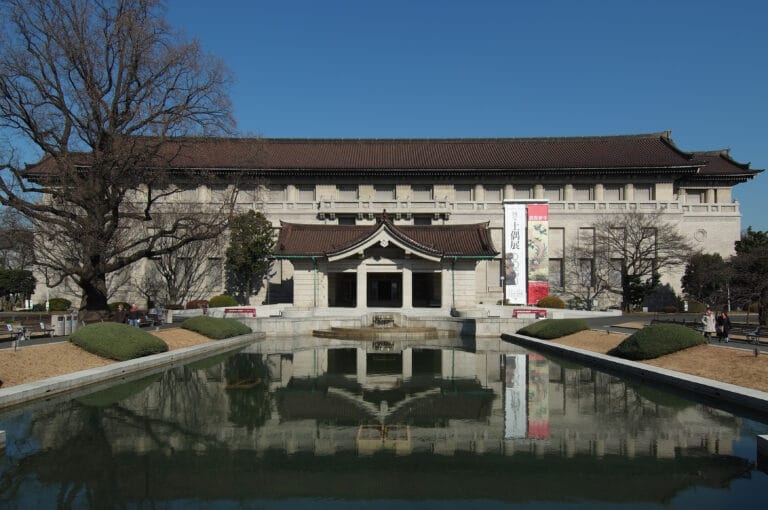
Another important strength is the way the museum is organized across multiple buildings. This could easily feel fragmented, but in practice it helps visitors approach the collection in a more deliberate way. Tokyo National Museum is not best experienced as a museum to “finish” all at once. It is better understood as a campus of related experiences. That is why many visitors find that choosing one building and doing it properly leads to a stronger visit than trying to race through everything. The museum rewards depth, and its structure supports that.
Collection Highlights
The Honkan, or Japanese Gallery, is the heart of the museum for many first-time visitors and one of the strongest introductions to Japanese art anywhere. This building gives the clearest chronological and thematic route through the major developments of Japanese material and visual culture. It is especially strong because it allows visitors to see how forms, techniques, and values evolved over time while still maintaining the distinct identity of each period. This is where the museum’s larger purpose becomes clearest: it is not only displaying great objects, but showing how Japanese history can be read through making, ritual, warfare, ceremony, and taste.
Buddhist sculpture is one of the museum’s great strengths. These works often provide some of the most powerful encounters in the entire institution. Carved wood, lacquer, bronze, and gilt surfaces carry an extraordinary balance of serenity, weight, and spiritual intensity. These sculptures do not depend on theatrical display. Their force often comes through posture, stillness, and the concentrated expression of sacred presence. For many visitors, these rooms become one of the emotional centers of the museum because they reveal how deeply religion shaped artistic production across many centuries.
Archaeological material is another major highlight, especially for visitors who want to understand the deep foundations of Japanese culture. Jōmon and Yayoi objects, ritual forms, clay figures, and excavated artefacts provide a very different kind of museum experience from later courtly or Buddhist material. These galleries are important because they show that Japanese history does not begin with polished temple culture or samurai aesthetics. It begins much earlier, through societies whose material remains still carry strong visual and symbolic power. The museum becomes richer when these early sections are not skipped.
Swords and armor are also naturally among the most compelling areas for many visitors. Yet the museum’s real achievement is that it presents them not only as military objects or symbols of prestige, but as things made with extraordinary craft and formal precision. A sword here is not merely a weapon. It is metallurgy, status, ceremony, and design held in one object. Likewise, armor becomes more than martial costume. It becomes a way of understanding power, identity, and visual display.
Ceramics, lacquerware, screens, painted scrolls, and textiles add another vital dimension. These works are among the clearest examples of how Japanese art often joins refinement with restraint. They may not always create instant dramatic impact, but they reward attention more deeply over time. This is one of the museum’s greatest virtues: it teaches visitors how to see quality in subtle line, glaze, weave, form, and decorative balance.
Building and Setting
Tokyo National Museum benefits enormously from its setting in Ueno Park, one of the city’s most important cultural zones. This location gives the museum a sense of openness and calm that strengthens the visit from the start. The transition from the busyness of Tokyo into the museum grounds already begins to shift the visitor into a slower pace. That matters, because this is a museum best experienced through concentration and quiet rather than hurry.
The museum’s multiple-building layout is one of its most distinctive features. Rather than forcing everything into one giant structure, it distributes the collection across separate spaces with different identities and emphases. This helps visitors approach the material more selectively and with more care. It also means the museum can feel less exhausting than a single vast encyclopedic building, provided the visit is planned well.
The garden is another important part of the experience. It is not merely an added attraction. It functions as a reset point, a space where the eye and mind can rest between galleries. In a museum where so many works depend on attention to detail and quiet judgment, that kind of pause is especially valuable. The garden helps make long visits more humane and more memorable.
Architecturally, the museum combines institutional dignity with a certain calm restraint. It does not try to overpower the visitor. Instead, it supports the collection through order, clarity, and an atmosphere suited to careful looking. This is exactly right for a museum whose objects often reveal their full strength gradually rather than instantly.
Practical Information
A very good way to approach Tokyo National Museum is to choose one building and do it properly, especially on a first visit. The Honkan is usually the best starting point because it offers the strongest overview of Japanese art and history. Trying to cover every building too quickly often weakens the experience. This is a museum where selectivity improves quality.
The museum is best approached with patience. A slower visit is almost always more rewarding than a comprehensive one. Objects here often require time. A screen, a robe, a ceramic vessel, or a Buddhist sculpture may not reveal itself in the first few seconds. Once visitors adjust to that rhythm, the museum becomes much richer.
Breaks are especially worthwhile. The garden and outdoor areas provide an excellent quiet reset, and using them can make a long visit far more enjoyable. This is one of the museum’s practical strengths. It is built for lingering, not for rushing.
Why Visit
Tokyo National Museum is best for art and antiquities lovers, first-time visitors to Tokyo who want a serious cultural anchor, and anyone interested in how a civilization can be understood through objects rather than slogans. Its greatest strength is the quality and range of its collection. It offers archaeology, Buddhism, court culture, arms and armor, decorative arts, and everyday refinement within one institution of remarkable depth.
What makes it worth prioritising is that it gives visitors something increasingly rare: a museum experience built around calm attention. It does not overwhelm through spectacle. It rewards patience, curiosity, and gradual understanding. That makes it one of the most satisfying museums in Japan.
For many visitors, Tokyo National Museum becomes unforgettable not because of one single masterpiece, but because of the cumulative force of the whole experience. The buildings, the garden, the pacing, and the quality of the collection all work together to create a museum that feels measured, serious, and deeply rooted in Japanese history. It is not only one of Tokyo’s essential museums, but one of the great museum visits in Asia.