Neues Museum
Archaeology Museums · Berlin, Germany. The Neues Museum in Berlin is a key institution for those interested in archaeology and ancient history. It forms part of the Museum Island ensemble, an area dedicated to several major museums on the…

Best forMuseum lovers, culture travelers, first-time visitors
Setting / nearbyBerlin, Germany
Overview
The Neues Museum in Berlin is a key institution for those interested in archaeology and ancient history. It forms part of the Museum Island ensemble, an area dedicated to several major museums on the Spree River in central Berlin. The Neues Museum reopened in 2009 after extensive restoration and reconstruction efforts following severe damage during World War II. It now functions primarily as a repository of archaeological artifacts, presenting objects from the prehistoric period through to antiquity with a focus on Egyptian and Classical civilizations.
Unlike many large museums shaped over centuries without coherent planning, the Neues Museum reflects a modern attempt to balance historic preservation with contemporary museum design. Visitors will find a blend of old and new elements in the building fabric, which itself tells a story of Berlin’s tumultuous 19th and 20th-century history. The museum concentrates on retelling human history through tangible cultural heritage. It appeals to visitors who appreciate archaeological collections and who want to deepen their understanding of early human civilizations through material culture.
Collection Highlights
The collection at the Neues Museum is broad yet concentrated on archaeology, emphasizing objects from Egypt, the Near East, and classical antiquity in the Mediterranean. Among the best known artifacts is the bust of Nefertiti, an exquisite example of ancient Egyptian royal portraiture. This painted limestone sculpture stands out for the level of craftsmanship and the insight it offers into artistic conventions and beauty ideals in the 14th century BCE.
Moving beyond Egypt, the museum’s collections cover a wide timespan, including prehistoric tools, jewelry, ceramics, and items from daily life in early European societies. Visitors can explore a rich range of classical antiquities with sculptures, pottery, and relics from Greek and Roman contexts. These objects illustrate the cultural exchanges and evolving artistic styles of the Mediterranean basin over centuries.
The Egyptian section is arguably the museum’s centerpiece and contains funerary goods, sarcophagi, and offerings, alongside everyday items that shed light on ancient beliefs and social structures. The attention to detail in the displays emphasizes both the ritual and practical aspects of these objects, offering a balance between artistry and historical context.
The classical antiquities hold statuary and inscriptions that help explain the development of democratic ideals, mythology, and imperial authority in ancient societies. While the museum does not present a comprehensive history of classical civilization, its artifact groups are assembled to highlight important cultural and technological achievements.
In addition, the prehistoric exhibits contribute a valuable perspective by tracing early human settlement in Europe and technological innovation such as stone tool-making. This part of the collection may attract those interested in human origins and anthropology.
Building and Setting
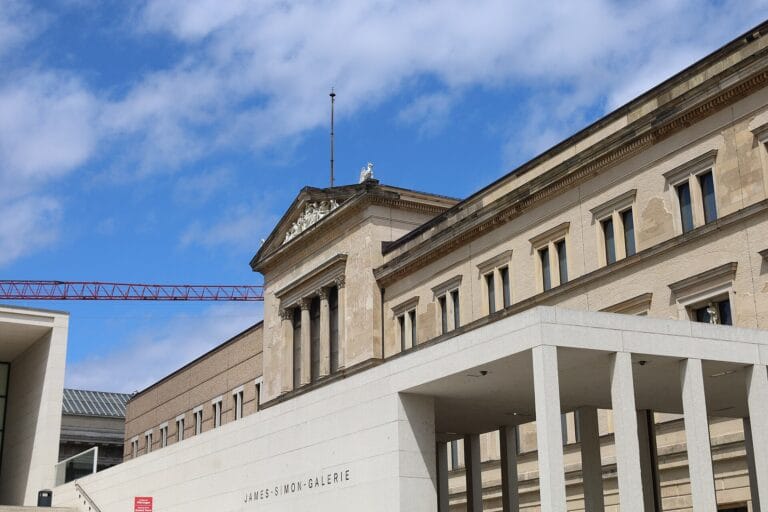
The Neues Museum is situated on Museum Island (Museumsinsel) in the historic center of Berlin. This island hosts multiple museums, making it a significant cultural and architectural destination. The museum itself was originally designed by Friedrich August Stüler in the mid-19th century. The building was heavily damaged during the bombing of Berlin in World War II, leaving it in ruins for decades.
The restoration, led by architect David Chipperfield and completed in the late 2000s, sought to preserve the war damage as part of the building’s narrative while integrating new structural elements and modern installation techniques. The result is a striking interplay of historic walls and contemporary interventions, lending the museum an atmosphere that invites reflection on its complex past.
Inside, the layout emphasizes clarity in the presentation of objects, with spacious galleries that allow visitors to examine details without feeling crowded. The lighting and display cases are designed to complement the light materials of the exhibits, particularly the subtleties of sculpture and ceramics.
The museum’s location on Museum Island means it is part of a cluster of renowned institutions, including the Pergamon Museum and the Altes Museum, allowing visitors to plan multiple visits in a single day if they choose. The surroundings reveal the layered history of Berlin, with nearby landmarks that emphasize the city’s role as a cultural crossroads.
Practical Information
Anyone planning to visit the Neues Museum should consult the museum’s official website for the latest information on opening hours, ticketing, and any restrictions. Museum Island is a popular area, which can result in busy conditions during peak tourist seasons. Visitors should be prepared for possible queues or timed entry requirements, especially for access to the most famous exhibits, such as the Nefertiti bust.
Information on guided tours, audio guides, and access arrangements should be verified before arrival. While the museum strives to accommodate various visitor needs, those requiring specific assistance should check current provisions and available services.
Additionally, because the Neues Museum focuses on archaeological and ancient art collections, visitors without a particular interest in these areas may find some galleries less engaging. Patience and an open mind will enhance the experience, but it is reasonable to prioritize sections that align more closely with personal curiosities.
The museum’s integration into Museum Island also means that visitors can consider combined tickets or passes that allow entry to multiple institutions in the area. Details on these options will typically be available on official platforms and at ticket counters.
Why Visit
The Neues Museum offers a distinct experience for visitors drawn to the material culture of ancient civilizations. Its collections provide considerable depth in artifacts from Egypt and the Mediterranean, creating an opportunity to engage with history through well-preserved and well-presented objects.
Visitors interested in art history or archaeology will find value in seeing the famed Nefertiti bust alongside a broader set of objects that range from everyday items to powerful symbols of antiquity. The museum contextualizes these pieces within human history, making it relevant not only to specialists but also to general audiences seeking to connect with the past in an accessible way.
The building itself is of interest beyond its contents. The juxtaposition of surviving 19th-century architecture with modern restoration efforts exemplifies post-war preservation challenges and how memory can be embedded in the fabric of a museum. As such, a visit also encompasses an architectural and historical dimension.
However, the museum may not cater equally to all interests. Those expecting a wide-ranging overview of world history or a comprehensive classical art gallery should note the Neues Museum’s specific archaeological and antiquities focus. In the context of Berlin’s larger museum landscape, it functions more as a specialist institution with strengths in ancient art and Egyptian collections rather than a broad art museum.
For individuals or groups curious about ancient civilizations, or those appreciating the tension between history and modern curatorship, the Neues Museum on Museum Island offers a considered and thoughtfully arranged collection. It occupies an important place within Berlin’s cultural offerings and contributes to the ongoing dialogue about cultural preservation and interpretation in a city marked by historical upheaval.