Museum of Islamic Art (Doha)
Museum of Islamic Art (Doha) is one of the Middle East’s most significant modern museums—built not only to display objects, but to set a cultural tone.
Best forMasterpieces, architecture, cultural history
Setting / nearbyMiddle East
Overview
The Museum of Islamic Art in Doha is one of the leading museums in the Gulf and one of the most recognizable museum buildings in the region. Managed by Qatar Museums, it presents Islamic art across a very wide geographical and historical span, with works from three continents and more than 1,400 years of artistic production. Rather than focusing on a single country or dynasty, the museum introduces visitors to the richness of Islamic civilization through objects made in places as different as Spain, Egypt, Iran, Turkey, Central Asia, and the Indian subcontinent. That broad approach is one of the museum’s greatest strengths: it helps explain Islamic art as a connected cultural world rather than a narrow or isolated tradition.
The museum is especially effective for visitors who want more than a quick look at decorative masterpieces. Its galleries show how faith, science, court culture, trade, scholarship, and craftsmanship all shaped the visual arts of the Muslim world. Ceramics, metalwork, manuscripts, textiles, glass, woodwork, jewelry, and scientific instruments appear side by side, allowing the visitor to see both artistic beauty and historical context. The institution therefore works well for first-time museumgoers, but it also rewards repeat visits from travelers and readers already interested in Islamic history, architecture, and material culture.
A visit here is not only about individual treasures. It is also about scale and presentation. The galleries are arranged to emphasize quality over clutter, and the museum’s setting on the Doha waterfront gives it an unusually calm and monumental atmosphere. For many visitors, the Museum of Islamic Art becomes one of the defining cultural stops in Qatar because it combines a world-class collection with one of the city’s most memorable architectural experiences.
Collection Highlights
The permanent collection is the main reason to visit. The museum is known for the depth and range of its holdings, which include Qur’an manuscripts, finely worked metal vessels, carved ivory, ceramics with bold glazing, carpets, miniatures, and scientific instruments. Together, these objects show that Islamic art is not one fixed style. Instead, it includes many local traditions connected by shared ideas, networks, and visual languages. One gallery might emphasize intricate calligraphy and manuscript culture, while another draws attention to geometry, vegetal ornament, or luxury courtly production.
Among the most compelling objects are those that reveal the relationship between beauty and knowledge. Instruments such as the astrolabe remind visitors that Islamic civilization made major contributions to astronomy, mathematics, and navigation as well as to the decorative arts. These kinds of objects give the museum an intellectual dimension that goes beyond surface elegance. They show that artistic refinement and scientific inquiry often belonged to the same cultural world.
The strength of the collection also lies in contrast. Delicate manuscript pages can be followed by monumental ceramic pieces or richly decorated metalwork. Carpets and textiles introduce another level of texture and craftsmanship, while glass and jewelry demonstrate technical skill on a smaller scale. Because the museum covers such a long time span, visitors can also trace change: the shift of forms across centuries, the movement of motifs between regions, and the ways dynastic taste shaped objects made for courts, scholars, and elite patrons.
Special exhibitions add another reason to return. Depending on when you visit, there may be temporary displays that open new perspectives on a region, theme, or artistic medium. That flexibility keeps the museum relevant for local audiences as well as for international travelers.
Building and Setting
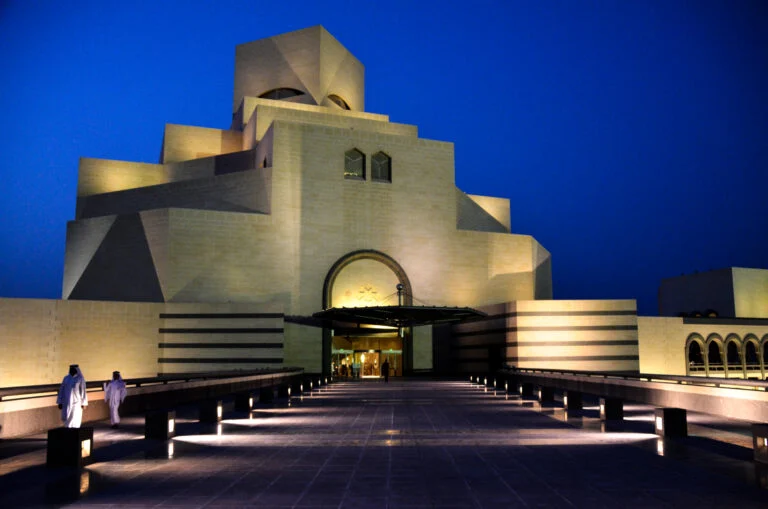
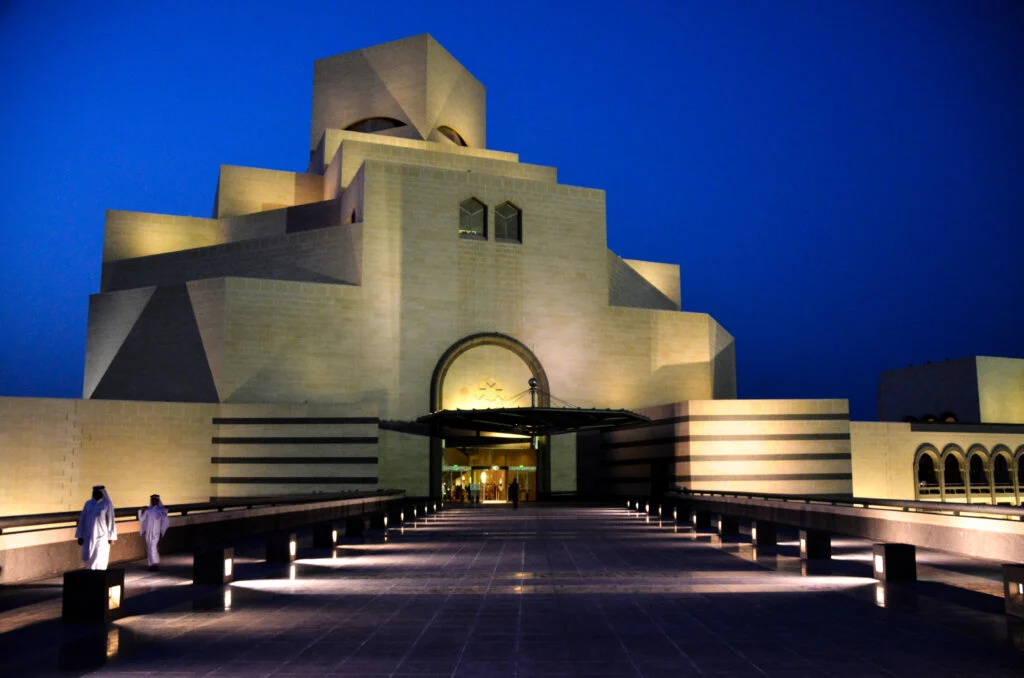
The building itself is one of the museum’s greatest attractions. Designed by I. M. Pei, it stands on its own island-like site off the Doha Corniche, giving it a strong physical separation from the surrounding city. This placement matters. It allows the museum to be approached almost as a monument, with open views of the water and skyline helping frame the experience before visitors even enter. The result is a building that feels ceremonial without becoming overwhelming.
Pei’s design is often praised for translating historic Islamic architectural ideas into a modern form. The architect drew inspiration from historic Islamic building traditions, but the final result is not a replica of any one structure. Instead, the museum uses crisp geometry, carefully stacked volumes, strong light and shadow, and a pale exterior that changes character throughout the day. This gives the building an unmistakable identity while still linking it to older architectural traditions from the Islamic world.
The interiors are equally important. The internal spaces match the exterior ambition, with a sense of order, balance, and controlled drama. Galleries are laid out to focus attention on the objects while still letting the visitor feel the scale of the architecture. Large windows and key viewpoints also connect the museum back to Doha Bay, so the building never feels sealed off from its surroundings.
Outside, the museum park and waterfront setting strengthen the visit. Even for those primarily interested in collections, the surroundings make it worth arriving a little early or staying a little longer. The approach, the water, and the skyline views all contribute to the museum’s reputation as one of Doha’s landmark cultural spaces.
Practical Information
For trip planning, the safest approach is to rely on the museum’s official visitor pages and ticketing system. The museum is best visited with enough time to explore both the architecture and the galleries properly rather than treating it as a short stop. Visitors with a strong interest in art history, Islamic material culture, or architecture will get the most from a slower visit.
The museum is well suited to different kinds of visitors. First-time visitors can enjoy it as an introduction to the history and artistic traditions of the Islamic world, while more experienced museum travelers will appreciate the breadth of the collection and the care of the display. It is also a strong choice for travelers in Doha who want a museum visit that combines art, history, design, and a major waterfront location.
Before visiting, it is always sensible to check the latest official information for opening hours, ticket policies, exhibitions, and visitor guidance. Details can change, and practical information is best confirmed directly before the visit.
Why Visit
The Museum of Islamic Art is worth visiting because it succeeds on several levels at once. It is an art museum with an important collection, an architectural landmark, and a cultural statement about Doha’s place in the wider museum world. Many museums are strong in one area and weaker in another. This one manages to combine collection quality, architectural prestige, and a memorable setting in a way that feels coherent rather than overdesigned.
For visitors new to Islamic art, the museum offers an accessible entry point into a vast subject. For experienced museum travelers, it offers enough depth and beauty to justify the trip. The broad historical range, the clarity of presentation, and the exceptional building all help make it one of the most rewarding museum visits in the region. If you are in Doha and want one museum that brings together art, history, architecture, and atmosphere, this is one of the clearest choices.