Iziko South African Museum
An editorial guide to Iziko South African Museum in Cape Town, where natural history, archaeology, and public scholarship meet in one of South Africa’s longest-standing museums.
Best forMasterpieces, architecture, cultural history
Setting / nearbyCompany’s Garden, it is not built around a single blockbuster object or a narrow contemp
Overview
Iziko South African Museum is one of Cape Town’s most important public institutions and one of the most useful places to understand how natural history, archaeology, scientific collecting, and the deeper human story of southern Africa intersect. Set in Company’s Garden, it is not built around a single blockbuster object or a narrow contemporary concept. Its importance lies in range. The museum brings together fossils, marine life, archaeology, rock art context, historical scientific collections, and broader displays connected to the natural and cultural history of the region. That breadth is one of its greatest strengths. Visitors are not just seeing isolated exhibits. They are encountering a museum that helps explain how southern Africa can be understood through land, species, time, and human presence.
What makes the museum especially rewarding is that it feels like an older kind of institution in the best sense. It carries the atmosphere of a place built to gather knowledge across categories rather than to present one tightly branded theme. This gives the visit a different texture from more contemporary museums built around a small number of immersive experiences. At Iziko South African Museum, the pleasure often comes from accumulation and connection. A fossil gallery may deepen your understanding of a wildlife display; an archaeology section may shift how you think about landscape; a historical scientific collection may reveal how knowledge itself was once organized. The museum becomes strongest when visitors allow these links to build gradually.
The museum is also particularly important because southern Africa is one of the richest regions in the world for thinking about origins, biodiversity, and deep human history. A museum like this matters because it provides public access to that scale of significance. Fossils, archaeological material, and environmental displays do not simply illustrate local curiosities. They point toward questions of evolution, extinction, migration, and long continuity. This gives the institution a much larger importance than its city setting alone might suggest.
Another of the museum’s strengths is that it complements Cape Town’s better-known cultural attractions by offering a different kind of depth. The city is often experienced through its scenery, its waterfront, its architecture, and its immediate history. Iziko South African Museum adds a wider frame. It reminds visitors that Cape Town is not only a colonial and modern city, but also part of an ancient environmental and human landscape that extends far beyond recent centuries. That widening of time is one of the museum’s most valuable contributions.
Collection Highlights
Natural history is one of the museum’s defining strengths and for many visitors the most immediately accessible part of the collection. Displays connected to southern African wildlife, marine life, birds, and biodiversity help make the region’s environmental distinctiveness visible. These galleries matter because they show that the natural history of South Africa is not background scenery. It is one of the foundations of the country’s identity and scientific importance. The museum becomes especially rewarding when these displays are approached not as static specimens alone, but as part of a larger story about habitat, adaptation, and ecological richness.
The fossil and paleontological material is another major highlight. This is one of the clearest reasons the museum carries weight beyond local interest. Southern Africa has a globally important relationship to the story of life and human origins, and the museum’s displays help make that importance accessible. Fossils here are not just impressive remains from a distant past. They are evidence of environments, extinctions, and evolutionary histories that changed the world. For visitors willing to slow down, these galleries can become some of the most powerful in the museum because they stretch the imagination across immense spans of time.
Archaeology is equally important. The museum’s archaeological sections help show that the human story in southern Africa is deep, complex, and central to world history. Stone tools, excavated material, and displays related to early societies give the museum an intellectual seriousness that extends far beyond conventional local history. These sections are especially valuable because they help visitors understand that southern Africa is not peripheral to the human story. It is one of the places where that story is most profound.
The museum’s treatment of San rock art and related interpretive material is another major strength. These sections can be especially rewarding because they widen the museum from natural history and archaeology into systems of meaning, belief, and visual expression. Rock art is not simply decorative heritage. It is evidence of thought, ritual, perception, and relation to land. When presented well, it becomes one of the museum’s most distinctive contributions. It helps connect human imagination to environment in a way few other museum subjects can.
Marine displays are also often memorable, especially in a Cape Town museum where the sea is never far from the city’s life. These sections work well because they tie local geography to biological richness and to the larger oceanic world surrounding southern Africa. They remind visitors that Cape Town’s location matters scientifically as well as historically.
Building and Setting
The museum’s setting in Company’s Garden is one of its quiet strengths. This location gives the institution a calmer and more reflective atmosphere than a heavily commercial urban site would. The museum feels part of a broader civic and cultural landscape, one linked to walking, public space, greenery, and older Cape Town institutions. That suits it very well. A museum concerned with deep time, natural history, and long human presence benefits from a setting that slows visitors down before they even enter.
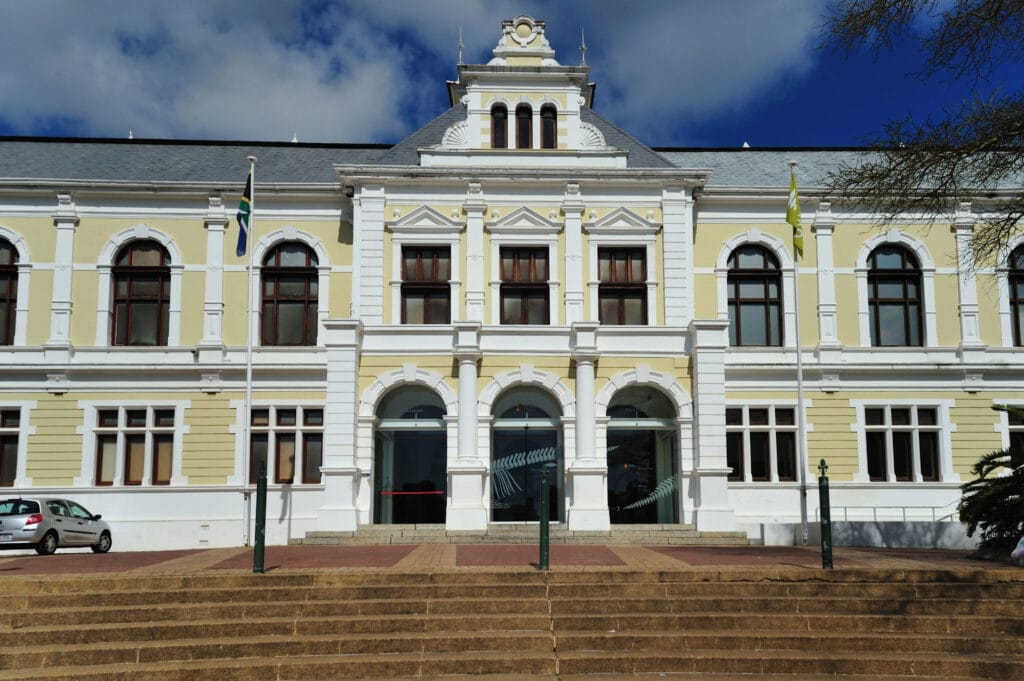
Architecturally, the museum has the character of an older public institution rather than a spectacular statement building. This is not a weakness. In fact, it supports the museum’s identity. The building feels like a place meant for collections, study, and public education rather than spectacle. That gives the visit a certain seriousness. The museum does not depend on dramatic architecture to announce its importance. It lets the depth of its collections do that work.
Inside, the building supports the sense of range that defines the institution. Different galleries can feel distinct in subject and mood, but that variety also contributes to the museum’s appeal. A visitor moves between natural history, archaeology, fossils, and interpretive displays in a way that reflects the older encyclopedic ambition of the institution. This can feel less polished than a tightly themed new museum, but it also makes the visit richer and more exploratory.
Its place in central Cape Town makes it especially useful as part of a broader day in the city. The museum does not require an isolated destination journey. Instead, it can be integrated naturally into a cultural route through the gardens and surrounding institutions, which adds to its practical appeal.
Practical Information
Iziko South African Museum is best visited with curiosity rather than a narrow highlight checklist. A good route is often to begin with natural history or fossil galleries, then move into archaeology and rock art-related material. This sequence works well because it moves from environmental and biological time into human time, allowing the museum’s larger story to build gradually.
The museum rewards slower looking, especially in archaeology and interpretive sections that may not shout for attention at first glance. Visitors who rush toward only the most visually obvious displays often miss what makes the institution distinctive. The museum is strongest when treated as a place of layered understanding rather than quick spectacle.
Because the museum has a broad scope, short pauses can help. The setting in Company’s Garden makes this particularly easy. A museum visit here pairs well with time outside, and that can improve concentration when returning to the galleries.
Why Visit
Iziko South African Museum is best for visitors interested in natural history, archaeology, deep human history, and museums that explain a place through long spans of time rather than only through recent events. Its greatest strength is its range. It gives Cape Town and South Africa a deeper frame by connecting the city to fossils, biodiversity, ancient societies, and systems of knowledge much older than modern urban history.
What makes it worth prioritising is that it offers a broader understanding of southern Africa than many visitors get elsewhere. The museum makes clear that this region is globally important not only for scenery or politics, but for science, human origins, and the natural world. That gives the visit real substance.
For many visitors, the museum becomes memorable because it quietly enlarges everything around it. After a visit, Cape Town can feel older, deeper, and more layered than before. That is a significant achievement for any museum, and it is why Iziko South African Museum remains one of the city’s most rewarding institutions.