Egyptian Museum
About: The Egyptian Museum in Cairo is one of the most important museums in the world for anyone interested in ancient history. Located near Tahrir.
Best forMasterpieces, architecture, cultural history
Setting / nearbyAfrica
Overview
The Egyptian Museum in Cairo is one of the most important museums in the world for anyone interested in ancient history. More specifically, it is one of the defining museums of ancient Egyptian civilisation, not only because of the scale of its collection but because of the directness of the experience it offers. Unlike newer museums that rely heavily on dramatic staging, digital presentation, or highly structured interpretation, the Egyptian Museum often feels more immediate and historically dense. It is a place where visitors encounter ancient Egypt through the sheer weight of original material. That gives the museum a distinctive atmosphere that many institutions cannot replicate.
Located near Tahrir Square, the museum has long been one of Cairo’s best-known cultural landmarks. For generations, it has served as one of the principal gateways into ancient Egypt for international visitors, scholars, and local audiences alike. Its importance lies not just in fame, but in the concentration of objects housed within it. The museum contains an extraordinary range of artefacts from pharaonic Egypt, from monumental sculpture to funerary material, royal treasures, mummies, inscriptions, and everyday objects. This breadth makes it possible to understand ancient Egypt not as an abstract civilisation reduced to a few famous names, but as a long and complex historical world.
Part of the museum’s character comes from the fact that it does not feel like a recently built, polished, highly choreographed institution. Instead, it feels historic in itself. The visit is shaped not only by the ancient objects on display, but by the sense of walking through a museum that has its own long place in the history of archaeology, collecting, and Egyptian cultural life. That atmosphere can be one of its greatest appeals. For some visitors, the museum may feel less streamlined than newer institutions, but that older, denser character is exactly what gives it force. It often feels less like a spectacular cultural product and more like a serious historical repository still carrying the weight of its past.
The museum is therefore best understood as a major collection museum rather than a single-icon destination. Famous objects matter here, of course, but the real value of the Egyptian Museum lies in accumulation. Room after room reinforces the scale of the civilisation behind the objects. The museum works especially well for visitors who are prepared to move slowly, look carefully, and accept a degree of visual overload as part of the experience. In return, it offers a depth that few museums of ancient history can match.
Collection Highlights
The strongest highlights of the Egyptian Museum are the funerary and royal collections, especially the material associated with Tutankhamun, ancient sculpture, sarcophagi, and mummies. For many visitors, the Tutankhamun material forms the emotional centre of the museum. Even in a collection of enormous scale, these objects stand out because of their craftsmanship, symbolism, and historical resonance. The funerary goods, decorative detail, and royal burial objects do more than impress visually. They reveal the extraordinary sophistication of ancient Egyptian beliefs about death, kingship, and the afterlife.
The sculpture galleries are another major strength. Large stone statues, carved heads, seated figures, and temple-related pieces give the museum some of its strongest sense of monumentality. These objects help visitors understand how Egyptian power, religion, and public representation were expressed across centuries. One of the most striking things about these galleries is the consistency of visual language combined with subtle variation over time. Even for visitors without specialist knowledge, the sculpture rooms make clear how central formal image-making was to Egyptian civilisation.
The sarcophagi and funerary displays also deserve more than a quick walk-through. In many museums, a few strong coffins or burial pieces may be used as supporting material around a central narrative. Here, they become a central narrative in themselves. The scale of funerary culture is one of the museum’s defining themes, and the repeated presence of coffins, masks, inscriptions, and burial objects gives visitors a stronger sense of Egyptian beliefs than a more selective display might. Rather than isolating only the most famous pieces, the museum shows enough material to make the larger system visible.
The mummy rooms, when included in the visit, are another important highlight. These spaces are often some of the most affecting in the entire museum because they bring the ancient world into direct contact with the present. The experience can feel more intimate and more unsettling than galleries dominated by objects alone. These are not symbolic representations of the dead, but human remains that carry extraordinary historical significance. For many visitors, these rooms leave one of the most lasting impressions in the museum.
It is also worth paying attention to the smaller artefacts that are easy to overlook amid the more famous material. Jewelry, tools, vessels, writing fragments, small statues, and domestic objects help balance the dominance of kings and tombs. They remind the visitor that ancient Egypt was not only a civilisation of monumental rulers and burial splendour, but also a society of daily practices, skilled labour, religion, administration, and craft. In a museum of this scale, the smaller objects often provide some of the clearest human detail.
Building and Setting
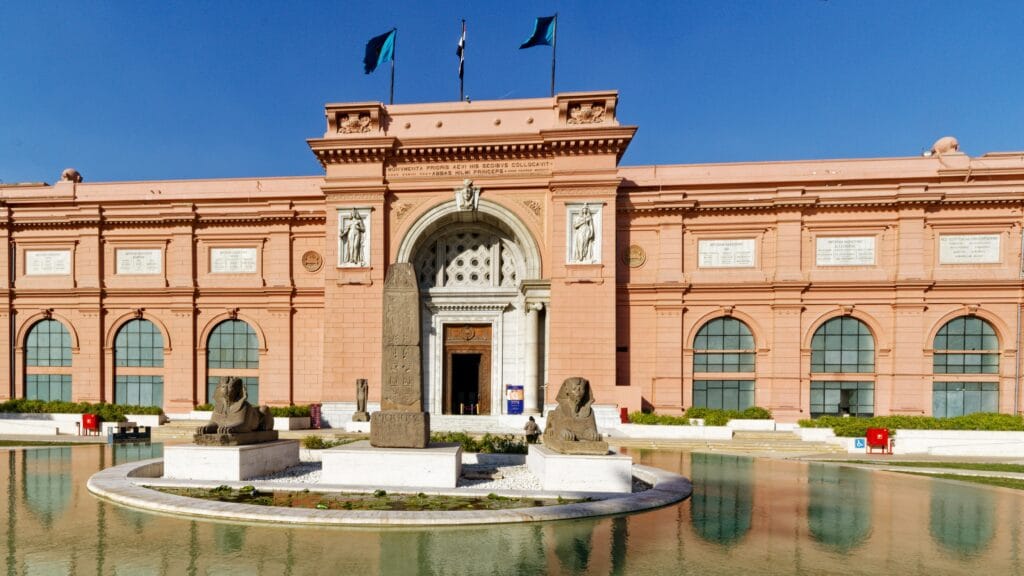
The museum’s building is an important part of the experience. It does not feel modern in the sense of glass, sleek circulation, or highly controlled gallery design. Instead, it has the character of an older major museum, one shaped by a different era of display. That means the building itself contributes to the sense of historical density. The visitor is not only seeing ancient objects. They are seeing them in a place that carries its own museum history, and this double sense of time is part of what makes the visit distinctive.
Architecturally, the museum has a monumental but somewhat restrained public presence. It feels formal, institutional, and established rather than experimental. Inside, galleries can feel crowded with material in a way that newer museums often avoid, but this is not necessarily a weakness. In the Egyptian Museum, that density often reinforces the impression of abundance. There is a sense that the building is holding far more history than any one visit can fully absorb.
Its location near Tahrir Square also matters. The museum sits in one of Cairo’s most symbolically charged and busy areas, and that central urban setting adds another layer to the experience. The contrast between the noise and energy of central Cairo outside and the immense span of ancient time within the museum is part of what makes the visit memorable. The museum does not feel isolated from the city. It feels embedded in it, which gives the experience a stronger civic and historical presence.
Practical Information
The Egyptian Museum is best approached with patience and a clear sense that you will not see everything properly in one short visit. The collection is too large and too dense for that. A useful strategy is to begin with the most famous material, such as the royal and funerary highlights, and then allow time for slower exploration of sculpture, smaller artefacts, and additional rooms afterwards. Without some structure, the museum can become overwhelming.
Because the museum can feel dense and visually demanding, pacing matters. It is often better to move in sections, allowing moments to pause and focus rather than trying to maintain the same speed throughout. Visitors with a strong interest in ancient Egypt can easily spend several hours here, while others may prefer a more selective route. In either case, the museum rewards concentration more than speed.
The central Cairo location makes it relatively easy to include in a broader city itinerary, but it is wise to allow enough time for the museum to stand as a substantial visit rather than a rushed stop between other attractions. This is not a museum that works best when treated as a checklist item. It needs time to register.
Why Visit
The Egyptian Museum is best for anyone seriously interested in ancient Egypt, for first-time visitors to Cairo who want to encounter one of the great historic collections of the world, and for travelers who value original material over polished presentation. Its greatest strength is that it offers ancient Egypt at scale. Not as a handful of celebrated masterpieces, but as a civilisation encountered through accumulation, detail, and physical presence.
What makes the museum worth prioritising is not only the fame of its objects, but the atmosphere of historical weight that surrounds them. This is a museum where the abundance of real artefacts creates its own kind of authority. It may not be the most streamlined or the most contemporary museum experience, but it remains one of the most substantial. For visitors willing to accept its density and move through it with care, the Egyptian Museum remains one of the most rewarding museum visits in Cairo and one of the essential museums of the ancient world.