Folk Heritage Museum Bhutan
Folk Museums · Thimphu, Bhutan. The Folk Heritage Museum in Thimphu focuses on rural life in Bhutan before rapid modernization took hold. It presents a detailed look at traditional Bhutanese village living, especially through the lens of architecture and…
Best forMuseum lovers, culture travelers, first-time visitors
Setting / nearbyThimphu, Bhutan
Overview
The Folk Heritage Museum in Thimphu focuses on rural life in Bhutan before rapid modernization took hold. It presents a detailed look at traditional Bhutanese village living, especially through the lens of architecture and everyday objects. Unlike many museums that concentrate on art or religious artifacts, this one frames its subject through its recreation of an old farmhouse and displays connected to farming, household crafts, and local customs. It attempts to preserve the way people lived in the countryside, at a moment when Bhutan was much less touched by outside influences.
Collection Highlights
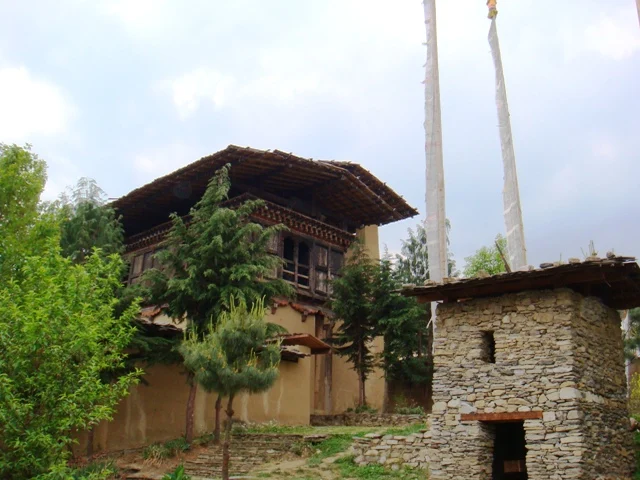
The heart of the museum is a restored three-story farmhouse, built in traditional Bhutanese style with timber construction and mud-mortar walls. Inside, the rooms serve as both exhibition areas and historic spaces. Visitors see the main living areas, including a kitchen with traditional clay stoves, utensils, storage chests, and woven baskets. Tools of agriculture and animal husbandry such as wooden ploughs, sickles, and ropes illustrate daily work outside. One floor is arranged with spinning wheels and looms, referencing textile production by women in the household.
Elsewhere, woven baskets and traditional clothing represent the practical crafts and regional dress of Bhutan’s rural communities. The museum also displays household objects like lamps, iron sickles, hand-carved wooden utensils, and earthenware pots. These pieces highlight how basic resources were transformed into functional items needed for survival in a high-altitude mountain environment.
The museum emphasizes continuity and change by showcasing how these items and practices gradually gave way to modern alternatives during the early 20th century. Interactive panels describe weaving techniques, agricultural cycles, and livestock care, providing context beyond the static displays. This makes the collection particularly useful for understanding how people lived and adapted before Bhutan’s economic reforms and infrastructural improvements.
Building and Setting
The Folk Heritage Museum is housed in an authentic traditional rural dwelling, itself a key artifact. The farmhouse was relocated from a remote area in Bhutan’s Gasa district to Thimphu. Reassembled carefully to preserve the original construction methods and materials, the building retains its three-level layout, including a stable and grain storage on the ground floor, living quarters above, and space for family activities on the top floor.
The architectural style incorporates Bhutan’s distinctive features such as ornate window frames painted in bright colors and timber joinery without nails. The mud walls are built to insulate against the harsh winters typical of Bhutan’s mountainous climate. The building sits in a small courtyard surrounded by gardens, which include vegetable beds and a small orchard to represent typical subsistence farming.
Located not far from Thimphu’s city center, the museum offers a contrast to the more modern surroundings. While the urban capital has expanded quickly in recent decades, this museum preserves one of the more traditional physical environments from rural Bhutan’s past.
Practical Information
Visitors planning to see the Folk Heritage Museum should check the latest details on the official website for opening days, hours, and admission fees. The museum is in Thimphu, Bhutan’s capital, and is accessible by local transport or taxi from various parts of the city.
Because it is a specialized museum in a region with distinct challenges related to terrain and infrastructure, advance information on accessibility and available visitor services is advised. Understanding international visitor entry rules for Bhutan is also helpful since the country’s tourism policies can impact travel plans.
The museum’s modest size typically means visits will take around an hour or so, depending on how much time is spent exploring the farmhouse and reading the interpretive materials. It does not generally provide extensive guided tours or audio guides, so visitors benefit from some prior reading about Bhutanese culture and history to get the most out of the visit.
Why Visit
The Folk Heritage Museum stands out by focusing on the physical environment of traditional rural life. Instead of concentrating on religious art or high culture, it presents everyday life in a tangible way that reveals the workings of a Bhutanese village household before the 20th century. This direct connection to a rural farmhouse makes it easier to imagine how people lived, worked, and maintained their homes in a mountainous landscape.
If your interest lies in anthropology, ethnography, or vernacular architecture, the museum supplies concrete examples, rather than abstract concepts, of Bhutan’s peasant culture. It can clarify discussions about Bhutan’s rapid changes over the last century through the details of housing, tools, and crafts.
A potential downside is that the museum does not have a large collection of movable artifacts beyond those tied tightly to the farmhouse itself. For someone looking for comprehensive ethnographic collections or broader historical narratives of Bhutanese culture, other institutions in Thimphu such as the National Museum or the Textile Museum may offer different perspectives.
The museum’s emphasis on the physical layout and material culture of a typical rural home encourages visitors to think about everyday survival strategies, resourcefulness, and the interrelation between architecture and environment. It also illustrates how modernization reshaped ordinary life.
This approach means the Folk Heritage Museum is a good complement for those assembling a fuller picture of Bhutan, providing a layer often overlooked by museums centered on art or religion. Instead of neat labels and isolated objects, it invites thought about how buildings and tools embody the knowledge and routines of past lives. That focus can be especially interesting for anyone curious about the practicalities of traditional mountain farming and household economies.