Ara Pacis Museum Review
Archaeology Museums · Rome, Italy. The Ara Pacis Museum in Rome occupies a unique position among the city’s many archaeological and art institutions due to its modern architectural approach to displaying an ancient monument. The museum’s centerpiece is the…
Archaeology Museums · Rome, Italy. The Ara Pacis Museum in Rome occupies a unique position among the city’s many archaeological and art institutions due to its modern architectural approach to displaying an ancient monument. The museum’s centerpiece is the…
Best forMuseum lovers, culture travelers, first-time visitors
Review focusCollections, visitor experience, and practical planning
Historical Context
The Ara Pacis Museum in Rome occupies a unique position among the city’s many archaeological and art institutions due to its modern architectural approach to displaying an ancient monument. The museum’s centerpiece is the Ara Pacis Augustae (Altar of Augustan Peace), a monumental altar originally commissioned in 13 BCE to honor the peace and prosperity brought by Emperor Augustus following years of civil war. This altar was originally situated on the banks of the Tiber River, marking both a religious and political statement about the power and legitimacy of Augustus’ reign.
The altar’s survival through millennia is remarkable, but it was only in the 20th century that serious efforts were made to relocate it to a dedicated museum building designed explicitly for its protection and presentation. The current museum, opened in 2006, was designed to house the altar in a controlled environment that respects the monument’s historical and artistic significance. The building itself is contemporary in style, incorporating large panes of glass that allow natural light while shielding the monument from environmental damage. The context of the altar, within the wider Augustan narrative of art and propaganda, renders the museum a focal point for understanding early imperial Rome and its visual culture.
What You See on Arrival
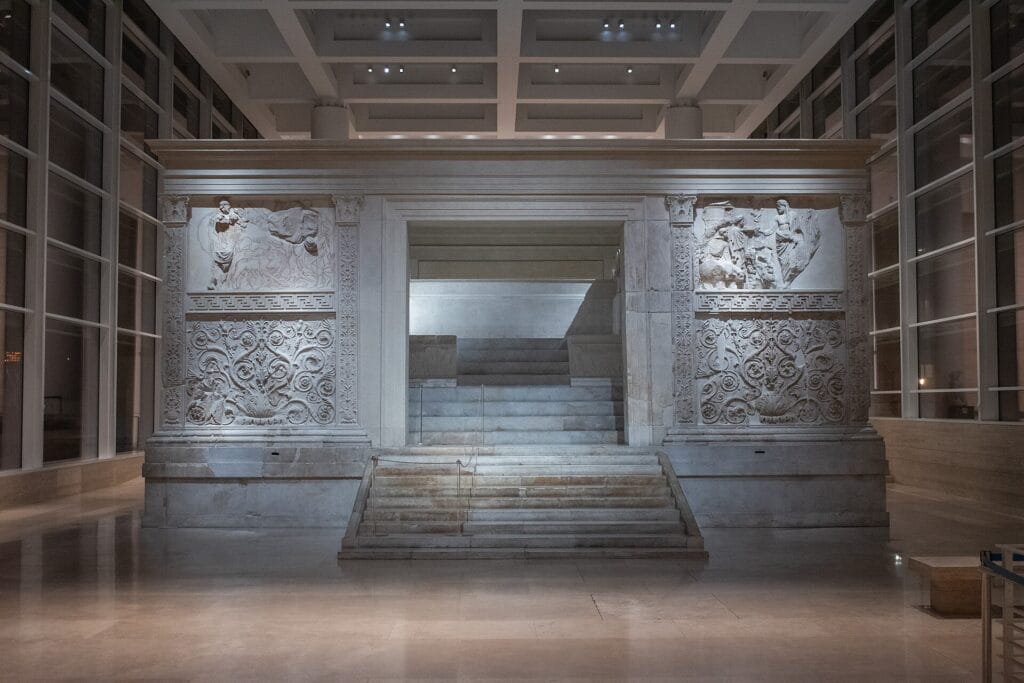
Approaching the Ara Pacis Museum presents an immediate dialogue between modern architectural transparency and antiquity. Situated on the busy Lungotevere, near the historic center, the museum’s glass enclosure acts as both a protective shell and a display window for the altar, visible from outside. The museum building does not attempt to imitate classical Roman architecture; instead, its sleek, minimalist lines establish a clear distinction between the ancient artifact and its modern setting.
Visitors encountering the building will notice the altar as the dominant visual anchor, housed within a spacious, well-lit interior space that privileges clarity and preservation over ornamentation. From this vantage point, the altar’s intricate marble carvings, featuring mythological and ceremonial motifs, immediately attract attention. The setting allows for an uninterrupted view of the monument while inviting further exploration inside the museum for context and interpretation.
The building’s transparent design naturally extends its reach to the urban environment, signaling the altar not as a hidden treasure but as a publicly accessible chapter of Rome’s cultural narrative. This contemporary framing makes the museum stand apart from many traditional Roman archaeological museums housed in historic palaces or underground settings.
Highlights and Key Exhibitions
The central object of the museum, the Ara Pacis Augustae, is a richly sculptural altar dedicated to Pax, the Roman goddess of peace. The altar’s altar screen is decorated with elaborate reliefs depicting processions, mythological figures, and symbols of fertility and harmony. These reliefs include figures such as Augustus and members of his family, priests performing rites, and allegorical personifications that link Augustan rule to divine favor and civil tranquility.
The museum’s interpretive approach helps decrypt these images for visitors, emphasizing how the altar worked as propaganda. Augustus used the Ara Pacis not only as a religious artifact but as a visual assertion of his regime’s legitimacy and the peaceful order he imposed after decades of conflict. The prominent relief showing a procession of the imperial family with realistic portraiture alongside idealized figures reflects Augustan ideals of piety, fertility, and dynastic continuity.
Beyond the altar itself, the museum provides context on Augustan art and Rome’s urban development, often illustrating how this monument related to the surrounding forum and the Tiber River’s role in the city’s geography. This broader historical and political context is important because it helps situate the altar within the lived experience of Romans at the time and the uses of public art as messaging.
The museum’s layout clusters the archaeological object with explanatory panels, drawings, and occasionally sculptural fragments linked to Augustan art. The focus remains tight: it avoids dispersing attention over unrelated artifacts, concentrating instead on the altar’s artistic program and historical setting. Visitors interested in Roman art, political iconography, or early imperial history will find detailed material here, but those seeking a broad sweep of Roman archaeology may find the scope narrow.
Visitor Experience
The museum’s design encourages a deliberate, contemplative pace of viewing rather than a frenetic race through numerous objects. The sizeable glass enclosure establishes a spatial buffer around the altar, allowing visitors to walk several circuits to appreciate the detailed reliefs from different angles. The use of natural light assists in bringing out the marble’s textures, although depending on the time of day, reflections on the glass can sometimes challenge visibility.
Interpretative materials are generally scholarly and focused, with clear labeling and introductory texts that elucidate key motifs, figures, and symbolism. For visitors with a background or strong interest in ancient history, this will deepen appreciation. For more casual tourists, the museum can feel demanding, given its singular focus and the dense iconography embedded in the reliefs. There is no large array of multimedia installations or interactive elements catering to every learning style; interpretation is mostly textual and visual.
Crowd management is an important consideration since the altar’s enclosure forms a natural bottleneck. During peak tourist seasons, the tight space can become crowded, restricting movement around the altar. Visitors sensitive to noise or looking for calm may find the proximity to a busy Rome street less than ideal. Still, the museum’s location close to other major sites makes it easy to incorporate into a walking itinerary of Rome’s historic center.
The museum’s focused scope means it is best approached either by visitors specifically interested in this monument or as a complement to broader explorations of Roman imperial art elsewhere in the city. It is less suited to those expecting a large collection or a varied display across different periods and media.
Tickets, Access, and Planning
The Ara Pacis Museum operates with fluctuating conditions that can affect planning: opening hours, admission requirements, and visitor services vary with Rome’s wider tourism policies and occasional conservation needs. Prospective visitors considering a trip to the museum should consult the official website for the most current information before making arrangements.
The museum’s relatively small size and its situation in a busy urban zone mean that ease of access depends somewhat on local transport capacity and pedestrian flow. It is well connected by public transit given its central position, but traffic congestion in the area may affect arrival times. Due to its glass architecture, certain weather conditions, including bright sunlight or rain, might influence visitor comfort or the viewing experience inside.
Visitors may want to plan their visit outside peak periods to avoid crowding. Given the close quarters surrounding the Ara Pacis itself, a moderate volume of visitors at once enhances the experience by allowing a more intimate engagement with the monument’s visual details.
Final Verdict
The Ara Pacis Museum in Rome fills an important niche in the city’s rich tapestry of archaeological institutions by offering a focused, carefully controlled environment for experiencing one of ancient Rome’s most significant imperial monuments. Its architectural design, while a departure from traditional museum buildings, reinforces the dialogue between antiquity and the present day.
The museum’s strength lies with the Ara Pacis Augustae itself—a sculptural masterpiece whose evocative reliefs convey themes of peace, family, and imperial power in a way that continues to fascinate historians and art lovers alike. The exhibition’s interpretive materials provide solid, contextually grounded insights, although the museum’s narrowly defined content and quieter style may limit appeal among general audiences or those expecting a more diverse museum program.
Planning a visit requires attention to seasonal crowd patterns and up-to-date practical information from the museum’s official sources. Once managed, the museum rewards those willing to engage closely with the monument’s artistry and message. In sum, the Ara Pacis Museum is particularly suitable for visitors who appreciate focused archaeological display and wish to explore one particular but significant facet of Rome’s imperial past in some depth.